 Seoul Window
The short answer
- Korea's tourism ministry says 2026 passed the all-time annual record of 18.94 million foreign visitors on October 27, about two months earlier than 2025 reached it. The provisional count through October 26 was 18.91 million.
- From January to September, arrivals rose 21.5% to 17.11 million, while Japan fell 2.9% and Thailand 3.8% over the same months.
- Foreign card spending on tourism hit a record ₩15.94 trillion (+47.7%), and 4.82 million visitors entered through airports and seaports outside the Seoul area.
- For your trip: book earlier, expect queues in Seongsu and Myeongdong, and if a taxi or shop overcharges you, call 1330.
Korea has never had this many visitors. By late October, more foreigners had come in 2026 than in any full year before, and the government is now talking about 20 million by the third week of November.
That shows up in shorter ways too: longer lines, fuller hotels and more complaints. Here is what the official numbers say and what they mean if you are planning a trip.
How many foreign tourists visited Korea in 2026?
About 18.91 million by October 26, a new record. In its October 27 press release, the Ministry of Culture, Sports and Tourism (MCST) said the 2026 count passed the previous annual record of 18.94 million, set in 2025, on October 27. That date is an estimate: the ministry based it on the provisional count to October 26 plus a daily average of about 64,000 arrivals this year.
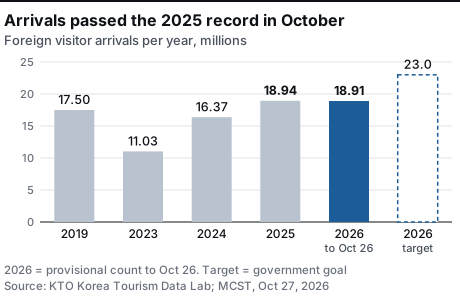
For context, the pre-pandemic peak was 17.50 million in 2019. Arrivals fell to under a million in 2021, recovered to 11.03 million in 2023 and 16.37 million in 2024, then set a record in 2025. All of those are Korea Tourism Organization (KTO) annual counts.
What comes next is a forecast, not a result. As of October 27, the ministry expects about 1.94 million visitors in November, which would push the annual total past 20 million in the third week of November for the first time, and it hopes to reach its 2026 target of 23 million by December 31. The longer-term national goal is 30 million a year.
Which months were busiest?
March, April, July, August and September each topped 2 million arrivals, and August was the busiest month ever recorded. Every month in 2026 so far has beaten the same month of 2025 by double digits.
📅 Foreign arrivals and card spending by month, 2026
| Month | Arrivals | vs same month 2025 | Card spending (₩ bn) |
|---|---|---|---|
| January | 1.27M | +13.3% | 1,175.2 |
| February | 1.43M | +25.7% | 1,068.3 |
| March | 2.05M | +26.7% | 1,714.4 |
| April | 2.03M | +18.8% | 1,994.5 |
| May | 1.95M | +19.4% | 2,123.5 |
| June | 1.99M | +23.1% | 2,057.0 |
| July | 2.09M | +20.8% | 1,953.0 |
| August | 2.25M (record) | +23.3% | 1,984.7 |
| September | 2.06M (provisional) | +21.1% | 1,871.0 |
Arrivals for January to August are KTO counts; September and all card spending figures come from the MCST release of October 22. Card spending includes online purchases.
If you want the full country-by-country and month-by-month breakdown, it is in our Numbers: visitors page.
Is Korea growing faster than Japan and Thailand?
Yes, by a wide margin this year, although Japan is still far bigger. The tourism ministry compared January–September figures from each country’s tourism statistics.
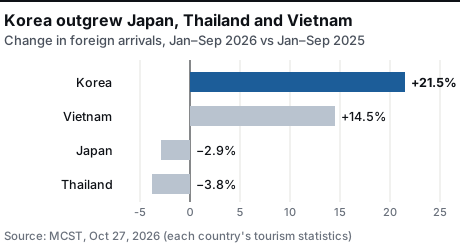
The ministry credits K-culture, more flights, easier visas and better transport for visitors. For travelers the practical side is entry rules. To check if you need a K-ETA, see K-ETA and visa-free entry by nationality and what happens to the K-ETA waiver in 2027.
Who is visiting Korea in 2026?
Mostly travelers from Greater China and Japan, with fast growth from Taiwan and Indonesia. Greater China (mainland China, Taiwan, Hong Kong and Macao) made up 46.3% of January–September arrivals and grew 29.1%. Japan made up 18.2%, the Americas, Europe and Oceania together 17.9%, and the rest of Asia and the Middle East 17.1%.
🌏 Largest source markets, January–September 2026
| Market | Arrivals | vs Jan–Sep 2025 |
|---|---|---|
| China | 5,473,078 | +29.2% |
| Japan | 3,118,815 | +16.9% |
| Taiwan | 1,864,368 | +32.4% |
| Hong Kong | 546,275 | +18.6% |
| Philippines | 507,288 | +15.6% |
| Vietnam | 458,107 | +10.6% |
| Indonesia | 330,629 | +23.4% |
| Singapore | 276,899 | +12.1% |
| Thailand | 253,291 | +14.3% |
| Malaysia | 231,948 | +7.9% |
The ministry’s release groups the United States into the Americas (1,624,403 arrivals, +12.0%), so it is not in the table. KTO’s January–August count puts the US fourth, with 1,079,727 arrivals (+10.8%). Europe as a whole sent 1,189,725 (+20.0%).
Two more details from the same release: 62.4% of visitors were women, and 49.8% were in their 20s or 30s. For how this compares with past years, read who visits Korea the most.
Where are visitors spending and going?
Shopping first, and more of it outside the usual places. Of the ₩15.94 trillion in foreign card spending from January to September, shopping (department stores, large marts, duty-free shops) took 37.0%, accommodation 19.6% and medical and wellness (hospitals, pharmacies, cosmetics road shops, makeup) 16.6%.
Seoul takes the lion’s share. The Seoul Metropolitan Government reported on October 6 that 11.56 million foreigners visited the city from January to August (+21.6%) and spent ₩7.78 trillion by card there (+59.9%), 71.1% of all foreign offline card spending in Korea. Growth was strongest in:
- Seongsu: foreign card spending +103.7%, and +206.6% around Kyungsu Elementary School, +109.3% on the Seongsu-dong café street
- Myeongdong area: +74.7%
- Gwangjang Market: +127.4%, and Namdaemun Market +67.9%
- Near Dosan Park in Gangnam: +240.1%, the biggest jump the city reported
Myeongdong is still the center of gravity. According to the Korea Herald, a Lotte Members analysis of KTO data found that Myeongdong alone accounted for 27.8% of foreigners’ spending nationwide in May 2026, with Seongsu-dong second at 5.7%. Our guide to where tourists go in Seoul now tracks that shift, and foreign tourist spending by nationality shows who buys what.
Outside Seoul, the share of visitors entering through regional gateways reached 28.2%, the highest this year. Airports such as Gimhae (Busan), Jeju, Cheongju and Daegu handled 3.24 million arrivals (+37.4%), and seaports such as Busan, Jeju and Yeosu 1.58 million (+14.5%). Visits to regions, counted from mobile network data as a stay of two hours or more, rose to 64.72 million from 54.07 million (+19.7%).
Are tourist complaints and overcharging rising?
Yes. Complaints have grown with arrivals, and taxi complaints are mostly about fares. KTO publishes complaints filed through its tourist complaint center and the 1330 hotline as open data.
📋 Tourist complaints by category (KTO open data)
| Category | 2024, full year | September 2026 |
|---|---|---|
| Shopping | 398 | 86 |
| Accommodation (all types) | 258 | 53 |
| Taxi | 309 | 36 |
| Airport and airlines | 165 | 35 |
| Restaurants | 98 | 27 |
| All complaints | 1,543 | 280 |
The share of taxi complaints that are about money is what stands out. In 2024, 60.2% of taxi complaints were about unfair fares or refusing to use the meter. In September 2026 it was 30 of 36 (83.3%). In shopping, the most common September complaint was a refund or exchange request (30 of 86).
Korea JoongAng Daily, citing the Korea Tourism Data Lab, reported 2,057 complaints from January to September, about double the 1,023 filed in all of 2019. It described a Japanese tourist charged ₩480,000 for a taxi from Myeongdong to Gimpo Airport, about 16 times the usual fare of around ₩30,000, after the driver skipped the meter and typed the fare in by hand, and a US visitor billed ₩15,000 extra for “utensils and side dishes”. Treat the yearly totals in news reports with some care: outlets citing the same data lab give different 2025 totals (1,744 and 1,593).
Practical tip
- In a taxi, check that the meter is running when you set off. Note the license plate and ask for a receipt.
- In shops and restaurants, check the price before you pay, and keep the receipt.
- Call 1330 (Korea Travel Helpline) from any phone in Korea, or +82-2-1330 from abroad. It runs 24 hours in Korean, English, Japanese and Chinese, with Vietnamese, Thai, Malay and Indonesian from 08:00 to 19:00, and it takes complaints.
Step-by-step help: how to report a taxi overcharge in Seoul, getting your money back, real overcharging cases and how to avoid scams in Seoul.
What does the record year mean for your trip?
More company everywhere, so plan a little earlier and spread out a little more.
- Book ahead for November. The ministry expects about 1.94 million visitors in November, close to May and June levels. Popular hotels and restaurant reservations go first. Our pre-trip booking checklist lists what to lock in.
- Expect lines in Seongsu and Myeongdong. Korea JoongAng Daily described a line dozens long outside a rice-cake shop in Seongdong District, about half of it foreigners. Go early on weekdays, and check how crowded Seoul is right now before you head out.
- Consider flying into another city. More visitors are already doing it: 28.2% entered outside the Seoul area this year. Busan, Jeju and Daegu have direct international flights.
- Don’t read the spending record as inflation. The 47.7% rise in card spending reflects more visitors and more shopping, not a price index. We could not find an official 2026 figure for hotel prices, so check rates yourself before you book.
- Know the complaint number. Save 1330 in your phone before you land.
Sources
- Ministry of Culture, Sports and Tourism — Foreign visitors pass all-time record two months early (October 27, 2026, with January–September detail)
- Ministry of Culture, Sports and Tourism — September 2026 inbound tourism trends (October 22, 2026)
- Korea Tourism Organization, Korea Tourism Data Lab — Annual visitor arrivals, 1975–2025
- Korea Tourism Organization, Korea Tourism Data Lab — August 2026 Korea tourism statistics
- Seoul Metropolitan Government — Foreign visitors to Seoul +21.6%, card spending +59.9% in January–August (October 6, 2026)
- Korea Tourism Organization — Tourist complaints by type, 2024 (Public Data Portal)
- Korea Tourism Organization — Tourist complaints by type, September 2026 (Public Data Portal)
- Hanam City — Tourist interpretation hotline 1330 (hours and languages)
- Korea JoongAng Daily — Korea set for record tourist numbers, but complaints are piling up (October 21, 2026)
- Korea Herald — Seongsu, Yeouido post faster growth in foreign visitors (September 13, 2026)