 Seoul Window
The short answer
- KBS had Korea's largest TV viewing share in 2025 at 21.584%, counting KBS1, KBS2 and its other channels together. MBC was second (11.432%) and CJ ENM, owner of tvN and Mnet, third (9.058%), per the Korea Media and Communications Commission (September 30, 2026).
- The four free-to-air broadcasters (KBS, MBC, SBS, EBS) add up to 41.68%, the four general programming channels (TV Chosun, JTBC, MBN, Channel A) to 21.78%. Those eight groups alone hold 63.46%.
- Korea had 36.15 million pay-TV subscriptions in the second half of 2025, 59.6% of them IPTV. That is why channel numbers change from one TV provider, and one hotel, to the next.
- In English, look for Arirang TV and KBS World. To see broadcasters in person, go to KBS On in Yeouido or the Sangam DMC media district, and check opening details on official sites first.
Switch on the TV in a Seoul hotel and you can flick through dozens of channels without anyone telling you which are the big networks and which are cable. If you know Korean dramas from Netflix credits, it is not obvious how tvN or JTBC relate to KBS either. Here is a map of Korean television built from official figures, as of October 2026.
What will you see when you turn on a hotel TV in Korea?
Four layers of channels: free-to-air networks, general programming channels, news channels and ordinary cable channels. One remote scrolls through all of them, but they have different licences and make money in different ways.
📺 The layers of Korean TV (as of October 2026)
| Layer | Main channels | How it reaches you | What it is |
|---|---|---|---|
| Free-to-air (terrestrial) | KBS1, KBS2, MBC, SBS, EBS | Free antenna signal, plus every pay-TV service | Public (KBS, EBS), ad-funded public (MBC), commercial (SBS) |
| General programming (jongpyeon) | JTBC, TV Chosun, Channel A, MBN | Cable, IPTV, satellite | Newspaper-affiliated, all launched December 1, 2011 |
| News channels | YTN, Yonhap News TV | Cable, IPTV, satellite | 24-hour news |
| Cable channels | tvN, Mnet, OCN (CJ ENM); ENA (KT); JTBC2, JTBC4 (JTBC) | Cable, IPTV, satellite | Entertainment, drama, music, sports and other genres |
| International / English | Arirang TV, KBS World | YouTube and others (local carriage varies by provider) | Made for viewers abroad |
Koreans call the free-to-air networks 지상파 jisangpa, literally “ground waves”. The second layer is 종편 jongpyeon, short for “general programming channel”: pay-TV channels allowed to air drama, entertainment and news, just like the big networks. When they launched in 2011 they got channel numbers right after the networks: JTBC 15, MBN 16, Channel A 18 and TV Chosun 19, a lineup the Korean press called the “golden channels”. Today’s numbers differ by provider.
ENA is not part of CJ ENM
The names look alike, so this trips people up. tvN, Mnet and OCN belong to CJ ENM. ENA belongs to KT. It started in 2003 as SkyHD, took the ENA name on April 29, 2022, and is the channel that aired Extraordinary Attorney Woo.
Then there are the services that carry those channels into a home or hotel: IPTV (KT Genie TV, SK Broadband B tv, LG U+tv), cable operators (LG HelloVision and others) and satellite (KT Skylife). They sell the channel packages, and they decide the channel numbers.
What is the difference between KBS, MBC and SBS?
Mostly where the money comes from. All three are free-to-air networks, but each has a different owner and funding model.
- KBS (Korean Broadcasting System): the public broadcaster. KBS1 has carried no advertising since the licence-fee system was reorganised in 1994; KBS2 does carry ads.
- MBC: classed as a public broadcaster but funded by advertising. Its shares are held by public-interest foundations.
- SBS: a commercial broadcaster, part of a listed holding-company group.
- EBS: the educational public broadcaster, which receives a slice of the licence fee.
The K-pop music shows follow the same split. KBS has Music Bank, MBC has Show! Music Core and SBS has Inkigayo, while M Countdown is on Mnet, CJ ENM’s cable side. How to get into a studio audience is covered in our guide to attending K-pop music shows.
Which Korean TV channel has the most viewers?
KBS, with a 21.584% viewing share in 2025, nearly double MBC’s 11.432%. That is from the annual viewing-share calculation the Korea Media and Communications Commission (KMCC) released on September 30, 2026, covering 290 broadcasting companies and 423 channels.
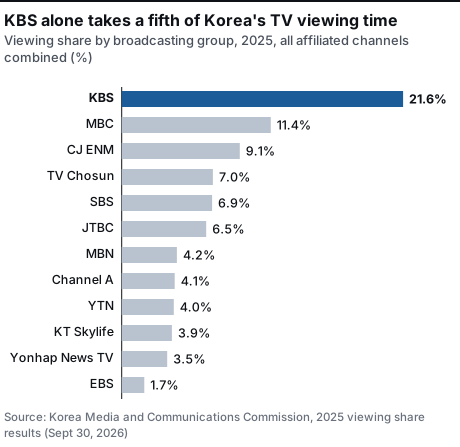
KBS on its own is roughly equal to MBC and CJ ENM put together. The one to watch is CJ ENM in third place: even with tvN, Mnet and its other channels added together, it lost 2.034 percentage points in a year, more than anyone else.
Viewing share is not a popularity chart
It is the share of all TV viewing time that goes to one broadcasting group. All of a group's channels are added together (KBS means KBS1, KBS2 and the rest), and the circulation of any daily newspaper in the same group is converted with a "media exchange rate" (0.51 in 2025) and added on. Regulators use it to watch for concentration of media influence, so it is not the same thing as a single show's rating. Streaming services such as Netflix and YouTube fall outside the definition.
📊 Top 12 broadcasting groups by viewing share, 2025 (KMCC, published September 30, 2026)
| Group | Type | 2025 share | Change vs 2024 |
|---|---|---|---|
| KBS | Free-to-air | 21.584% | +0.722 pts |
| MBC | Free-to-air | 11.432% | +0.454 pts |
| CJ ENM | Cable (tvN, Mnet and others) | 9.058% | −2.034 pts |
| TV Chosun | General programming | 6.997% | −0.444 pts |
| SBS | Free-to-air | 6.932% | −0.618 pts |
| JTBC | General programming | 6.483% | +0.338 pts |
| MBN | General programming | 4.233% | −0.521 pts |
| Channel A | General programming | 4.063% | −0.814 pts |
| YTN | News | 3.995% | +0.536 pts |
| KT Skylife | Satellite (KT group) | 3.853% | +0.166 pts |
| Yonhap News TV | News | 3.488% | +0.203 pts |
| EBS | Free-to-air | 1.732% | −0.127 pts |
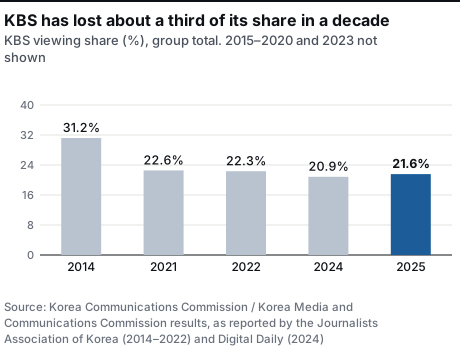
Over a longer stretch, KBS has slipped too. According to the Journalists Association of Korea, KBS had 31.210% in 2014, 22.555% in 2021 and 22.334% in 2022. Digital Daily reported 20.862% for 2024, and 2025 ticked back up to 21.584%. We could not confirm the 2023 figure, so it is left out of the chart.
The general programming channels have followed a similar path. As reported by the Journalists Association of Korea, their combined share fell from 26.650% in 2021 to 21.767% in 2022, and the 2025 total of 21.776% sits at about that level.
Do Koreans still watch TV?
Yes, but how they get it and what the screen is used for are changing. Pay-TV subscriptions stood at 36,150,070 in the second half of 2025, down 76,030 from six months earlier, according to the KMCC. IPTV was the only platform that grew.
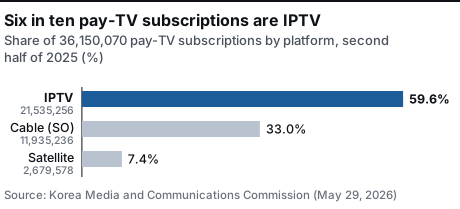
Hotel TVs are usually hooked up to one of these three, which is why KBS1 can sit on a different number in each room you stay in.
The same survey put streaming (OTT) use at 81.8%, a figure that includes free video such as YouTube. The interesting shift: people who watch streaming on a TV set rose from 23.8% to 36.4%. The living-room TV is turning into a screen for apps as much as for channels.
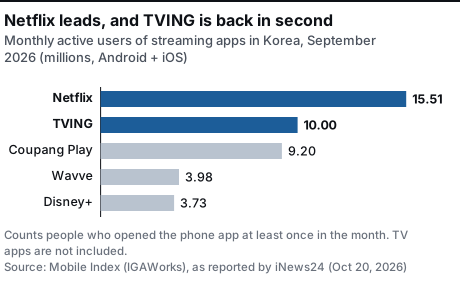
In Mobile Index data reported by iNews24, Netflix led in September 2026 with 15,507,477 monthly users, and TVING (9,995,372) took second place back from Coupang Play (9,198,289). These count people who opened the phone app at least once, so TV-app viewing is missing. Korean media linked TVING’s September jump to pro baseball coverage, tvN shows and users opening the app to claim compensation after a data leak. Month-to-month swings are big: in August, Coupang Play (10,067,459) was the top local service.
TVING and Wavve are still not one company. CJ ENM made Wavve a consolidated subsidiary in September 2025 and launched bundle passes, but according to NewsWay and Money Today, no final legal merger agreement had been signed as of October 2026. For more on streaming, see what Koreans watch on OTT and subscription prices in Korea.
How much is the TV licence fee in Korea?
₩2,500 a month (₩30,000 a year), unchanged since 1981. That figure comes from Wikipedia and Korean press reports; we did not check the legal text itself. Visitors never pay it. It is charged to households and businesses with a TV, and since 1994 it has been billed together with the electricity bill from KEPCO.
Here is how the last few years played out, as reported by the Journalists Association of Korea:
- July 2023: a decree change separated the fee from the electricity bill, fully in force from July 1, 2024. Within a month, the collection rate fell to the 80% range.
- December 26, 2024: the National Assembly passed a Broadcasting Act amendment to put the fee back on the power bill. The acting president sent it back for reconsideration, and it was passed again in April 2025.
- October 23, 2025: the amended law took effect, and the fee returned to electricity bills from the November 2025 bill.
- May 8, 2026: the KMCC approved a decree amendment deleting the separate-billing clause (per The Herald).
That ₩2,500 is what keeps KBS1 ad-free on the TV in your hotel or Airbnb.
Can you watch Korean TV in English?
Arirang TV is the surest bet. Run by the Korea International Broadcasting Foundation, it went on air in 1997 and broadcasts in eight languages. Its “Live from KOREA” stream runs 24/7 on YouTube, so if your room does not carry it, put it on your phone.
KBS World launched in July 2003 for viewers outside Korea. It airs KBS programs with subtitles in English, Chinese, Malay and other languages, and has an official YouTube channel. We could not confirm how it is carried on Korean IPTV or cable.
Don’t expect English subtitles on first-run Korean broadcasts. If you want to follow a drama in English, Netflix or the broadcasters’ official YouTube clips are the realistic route.
Finding channels on a hotel TV
- Look at the remote. A genie tv, B tv or U+tv logo means IPTV; otherwise it is cable or the hotel's own system.
- Press the program guide (EPG) button. It shows channel names next to their numbers, which is quicker than memorising anything.
- English channels such as CNN, BBC and Arirang vary by hotel. Ask the front desk for the channel list.
- With an antenna, Seoul-area free-to-air channels are said to show as KBS1 9-1, MBC 11-1 and SBS 6-1 (per Wikipedia), but pay-TV numbering can be different.
What can you actually do in Seoul?
Broadcasters cluster in two places: KBS in Yeouido and almost everyone else in Sangam DMC. Both are working offices, so think of a visit as a walk rather than a tour.
KBS On (KBS main building, Yeouido): 13 Yeouigongwon-ro, Yeongdeungpo-gu, a walk from Yeouido Station (Lines 5 and 9) or National Assembly Station (Line 9). The Yeongdeungpo District tourism page lists an exhibition on broadcasting history, a news-anchor experience and a virtual studio. We could not confirm opening hours, closing days, fees or booking, so check the official KBS website before you go. For food nearby, see our Yeouido food guide.
Sangam DMC media district: Digital Media City Station (Line 6, AREX and the Gyeongui–Jungang Line), Exit 9. The MBC plaza, SBS Prism Tower, JTBC, YTN, the CJ ENM center (where M Countdown is recorded) and Channel A’s Sangam studio are all in the same few blocks. Seoul’s media hub suggests a 40 to 50 minute loop from Mulbit Culture Park past the MBC plaza to DMC Star Park. Building exteriors and plazas are free to walk around, but we could not confirm any regular public studio tour. For places to eat, see our Sangam DMC guide.
Music show audiences: free, but you need to apply and be selected. Each broadcaster’s process is in our music show guide, and K-pop activities you can simply book are in K-pop experiences in Seoul.
N Seoul Tower: the tower on top of Namsan was built as a broadcast transmitter and today belongs to the news channel YTN (the observatory is operated separately). YTN launched in 1995 and was privatised in 2024, with Eugene Group as its largest shareholder.
Sources
- Korea Media and Communications Commission — 2025 viewing share results for broadcasters (September 30, 2026, via KDI Economic Information Center)
- ZDNet Korea — 2025 viewing share results, scope and media exchange rate (September 30, 2026)
- Digital Daily — 2024 viewing share results (April 20, 2026)
- Journalists Association of Korea — 2014 viewing share (July 16, 2015)
- Journalists Association of Korea — 2021 viewing share (December 14, 2022)
- Journalists Association of Korea — 2022 viewing share (August 2, 2023)
- Korea Media and Communications Commission — Pay-TV subscriptions at 36.15 million, second half of 2025 (May 29, 2026)
- Dailian — 2025 Broadcast Media Usage Survey results (December 30, 2025)
- iNews24 — Streaming app monthly users, September 2026, Mobile Index (October 20, 2026)
- Journalists Association of Korea — TV licence fee returns to electricity bills (October 29, 2025)
- The Herald — Decree amendment deleting separate billing approved (May 7, 2026)
- Wikipedia — Television in South Korea (terrestrial virtual channels)
- Wikipedia — Korean Broadcasting System
- Yeongdeungpo-gu Office — KBS On tourism listing