 Seoul Window
The short answer
- A tea omakase is a booked, seated tea tasting: a host pours a set run of teas, each paired with a small sweet or dish, over roughly 60 to 90 minutes.
- Where the seven Seoul tea bars in this guide publish a price, courses run ₩38,000 to ₩60,000 per person (as of October 2026), from Kenyan purple tea in Ikseon-dong to a Korean-tea "ceremony" by Seoul Forest.
- Booking is by Catchtable, Naver or Instagram/KakaoTalk DM. OMOT gives foreign guests an English script, and Osulloc Tea House Bukchon has an English Catchtable page.
- It is the modern counterpart to Seoul's traditional tea houses, where one walk-in cup costs ₩7,000 to ₩12,000.
Walk into a franchise coffee shop in Seoul and you will still wait behind ten iced Americano orders. But in the side streets of Seongsu, Yeonnam-dong and Bukchon, a different crowd is booking 75-minute slots weeks ahead to sit at a bar and watch someone pour white tea from Hadong. Korean media now calls this 차마카세 chamakase, or tea omakase.
This guide covers what you actually get, why it took off, seven places that run one in 2026, and how to book as a visitor.
What exactly is a tea omakase?
It is a tea tasting menu. You book a time slot, sit at a counter or shared table with a few other guests, and a host brews a sequence the house has chosen, usually three to five teas plus a welcome tea, each with a matched bite. The word comes from sushi omakase (“I’ll leave it to you”), and the format is the same: no menu decisions, one seating, a story told course by course.
Most courses in Seoul share a few traits:
- 60 to 90 minutes, starting on the hour for everyone in the room.
- Small rooms. Tipherence takes up to 6 people per slot, Cocosienna up to 8 and OMOT up to 12.
- Seasonal menus. OMOT changes its theme every four months; Chachaithe changes its sweets about every two weeks.
- Pairings called 다식 dasik, the small tea snacks of Korean tea culture, often reworked as tarts, jellies or parfaits.
- Explanation. The host talks through each tea: where it grew, how it was processed, why the water is cooler for this one.
Tea omakase vs afternoon tea
Hotel afternoon tea is a tiered stand of food with a pot of tea on the side. A tea omakase flips that: the teas are the main event and the food is there to frame them. Expect small portions. Gallery The Square in Gye-dong is the exception, with a meal-style course of salad, main and dessert.
Why are young Koreans trading coffee for tea?
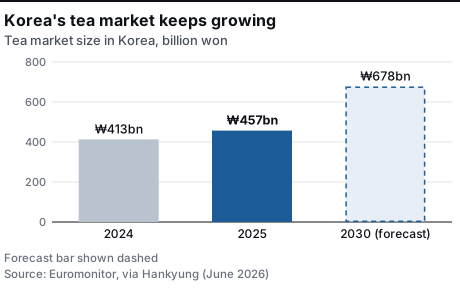
Health, slowness and novelty, in roughly that order. Tea is still a small market next to coffee, but it is growing fast and the new customers are young. Euromonitor figures cited by Hankyung in June 2026 put Korea’s tea market at about ₩457 billion last year, up 10.7% from ₩413 billion, with a forecast of ₩678 billion by 2030.
The same Hankyung report described the 23rd International Tea Culture Expo, which opened at COEX on June 4, 2026: about 40,000 people pre-registered and registration closed early. A Korea Tea Culture Association staffer said 20- and 30-somethings made up 50 to 60% of visitors to its tea-ceremony sessions. Tea classes, the paper added, now cost around ₩30,000 to ₩60,000 an hour for groups of four or five.
Why the switch? The Seoul city magazine Seoul Sarang (October 2026) pointed to “healthy pleasure”, meaning people managing caffeine without giving up a treat, and to the appeal of waiting: brewing tea is a break from a day of instant delivery and short-form video. It put the average cost of a tea omakase or tea course at ₩30,000 to ₩50,000 per person, and noted that tea gatherings in Seongsu now sell out the moment applications open.
So coffee is getting cheaper and more everyday, and tea is becoming the thing you plan for. For what a cup of coffee costs in Korea now, see our franchise coffee price guide.
Where can you book a tea omakase in Seoul?
These seven tea bars all ran a booked tea course in 2026. Prices below come from each place’s official site or its own Naver Place menu, as of October 2026, unless marked as visitor reports. Menus change by season, so check the booking page before you go.
🫖 Seoul tea omakase at a glance (prices per person, as of October 2026)
| Tea bar | Area | Course | Price | Length | Booking |
|---|---|---|---|---|---|
| OMOT | Seongsu (Seoul Forest) | 5 courses of Korean tea, from a welcome tea to a variation, with dasik | ₩48,000 | 75 min | KakaoTalk “OMOT”, Naver TalkTalk, Instagram DM, WhatsApp |
| Tipherence Seoul | Ikseon-dong | Kenyan purple tea served several ways, with desserts | ₩38,000 | About 1 hr (visitors) | Naver booking |
| Cocosienna Yeonnam Tea Lounge | Yeonnam-dong | Seasonal course of teas, tea variations and tea food | ₩50,000 | 80 min | Naver Map booking, Catchtable |
| Chachaithe | Hannam-dong | Welcome tea, a main tea you choose, closing tea, each with a tea sweet | About ₩29,000–32,000 (visitors) | 90 min | Catchtable |
| Gallery The Square (Gye-dong) | Bukchon | Meal-style course: salad, main, dessert, each with a tea | About ₩58,000 (visitors) | About 90 min (visitors) | Catchtable |
| Tea E. | Sinsa-dong | Tea course, or a tea-focused course | ₩55,000 / ₩60,000 | Ask when booking | Naver booking |
| Osulloc Tea House Bukchon | Bukchon | Seasonal course pairing Jeju teas with tea food | ₩39,000 | Not stated | Catchtable (Korean and English pages) |
1. OMOT — a Korean tea “ceremony” by Seoul Forest
OMOT calls its course a tea ceremony, and it is the place that takes Korean tea most seriously. Everything is organic Korean tea, served on teaware made with Korean artists, and the theme changes every four months. The September to December 2026 season, Obangsaek, is built on the five traditional Korean colors: a 2024 compressed white tea from Hadong to start, then a non-alcoholic mocktail inspired by chrysanthemum wine, a caffeine-free blend, the house signature blend, and a persimmon and jaeksal black tea milk-foam drink.
Ceremonies run Friday to Sunday at 12:00, 14:00, 16:00 and 19:00, last 75 minutes and cost ₩48,000 per person, with up to 12 guests. There is no deposit, but changes must be made three days ahead. The host speaks Korean; OMOT emails foreign guests a full English guide after booking and hands out an English script on the day. On Wednesdays and Thursdays the room is walk-in only, for single drinks. It is a no-kids space (children 8 and up with a guardian, at the adult price), closed Mondays and Tuesdays, and about 600m from Ttukseom Station Exit 8. Pair it with our Seongsu cafe list if you are spending the day in the area.
2. Tipherence Seoul — purple tea on the Seosulla-gil wall
Tipherence is a tea brand built around purple tea, a Kenyan highland tea whose leaves turn violet. Its Ikseon-dong building sits on Seosulla-gil, the lane that runs along the stone wall of Jongmyo Shrine. The purple teamakase is listed at ₩38,000 on its Naver Place menu, the lowest price in this guide. heyPOP reported in April 2026 that it runs only on Fridays, in four slots of up to six people; recent visitors describe a one-hour course in a third-floor classroom, with the tea served as a welcome drink, a milk tea and with desserts. Book through Naver.
3. Cocosienna Yeonnam Tea Lounge — a tea sommelier’s seasonal course
Cocosienna is a Korean tea brand with a fourth-floor lounge in Yeonnam-dong, a short walk from the Gyeongui Line Forest Park. Its seasonal tea course is 100% reservation, lasts 1 hour 20 minutes and starts at 11:00, 13:00, 15:00, 17:00 and 19:00, according to its official site. The Naver Place menu lists the tea omakase at ₩50,000. Reviews mention touching and smelling dried and brewed leaves between courses, and tea variations such as a hojicha tiramisu. Teas from the course are sold at the counter.
4. Chachaithe — tea sweets in Hannam-dong
Chachaithe is a tea-confectionery shop first, with a small booked tea room upstairs. The course is three teas, a welcome tea, a main tea you pick from about four, and a closing tea, each with a seasonal sweet; you can add a parfait. Esquire Korea listed it at 90 minutes. Visit Seoul lists hours of Tuesday to Saturday, 11:00 to 19:00, closed Sundays and Mondays, and it was picked for the 2026 Taste of Seoul cafe and dessert list. Visitors in 2026 report paying about ₩29,000 to ₩32,000 depending on the main tea. Book the tea room on Catchtable; Naver booking is for pastry pickup. It is about 600m from Hangangjin Station Exit 3.
5. Gallery The Square (Gye-dong) — a tea course you can call lunch
The Korea Tourism Organization describes Gallery The Square as a tea café with hanok views through a wide window and a meal-style course of salad, main and dessert, each with a tea. It runs four booked slots a day (12:00, 15:00, 17:00 and 19:00) and books through Catchtable. Visitors report about ₩58,000 for roughly 90 minutes; the Naver Place menu says the price varies. Note that its Haebangchon branch closed on November 30, 2025, so go to the Gye-dong address only.
6. Tea E. — a food-forward course near Garosu-gil
Tea E. is a small tea room near Garosu-gil in Sinsa-dong. Its Naver Place menu lists a tea course at ₩55,000 and a “tea-focused course” at ₩60,000, plus a ₩55,000 course for pregnant guests. Food is a bigger part of the experience here than at OMOT or Chachaithe. Book through Naver.
7. Osulloc Tea House Bukchon — the easiest to book in English
Osulloc grows its tea in Jeju, and its Bukchon house, a remodeled 1960s building, is the most visitor-friendly option here. Its official page lists a Bukchon seasonal tea course at ₩39,000 that pairs Jeju teas with tea food, and links to both a Korean and an English Catchtable booking page. Hours are 11:00 to 20:00 Monday to Thursday and 11:00 to 21:00 Friday to Sunday. The third floor has a non-alcoholic tea cocktail bar and a private room for tea-brewing classes.
How do you book a tea omakase as a visitor?
Pick the place first, then use whatever channel it uses. There is no single booking app for tea courses, and the rooms are small, so weekend slots go first.
- Catchtable: Chachaithe, Gallery The Square and Osulloc Tea House Bukchon. Osulloc links to an English Catchtable page from its official site.
- Naver booking: Tipherence Seoul and Tea E.; Cocosienna sends you to its Naver Map page to check open slots.
- Messages: OMOT books by KakaoTalk channel “OMOT”, Naver TalkTalk, Instagram DM, or WhatsApp in its English guide.
- Tell them about allergies when you book. Courses are fixed, and OMOT says it can’t change the teas in its course.
If Naver booking won't work for you
Naver booking is easiest with a Naver account. If sign-up stalls on a phone verification step, send the shop an Instagram DM in simple English with your date, time slot and party size. Small tea rooms answer DMs more often than phones.
Language
Most hosts explain in Korean. OMOT is the only one here that publishes an English script and guide for foreign guests. Elsewhere, ask when booking whether an English menu card is available, or keep a translation app open; the tea itself needs no translation.
Which Korean teas will you meet on a course?
Expect green tea, a fermented tea and at least one tea that is not from the tea plant at all. Korean courses mix all three, and knowing the words makes the host’s explanation easier to follow.
🌿 Korean tea words you will hear
| Term | Korean | What it means |
|---|---|---|
| Nokcha | 녹차 | Green tea. The main growing regions are Boseong (South Jeolla), Hadong (South Gyeongsang) and Jeju |
| Ujeon / Sejak | 우전 / 세작 | Grades by picking time. Ujeon is picked before Gogu (around April 20) from the youngest buds; sejak in late April to early May. Earlier usually means more delicate and pricier |
| Balhyocha / Hwangcha | 발효차 / 황차 | Fermented (oxidized) Korean teas. The labels are used loosely, so ask the host how dark it is |
| Jaeksal-cha | 잭살차 | Hadong’s traditional fermented tea, closer to black tea |
| Daeyongcha | 대용차 | Teas not made from the tea plant: omija berry, yuja citron, ssanghwa herbal tea, grains, flowers, mugwort |
| Malcha | 말차 | Powdered green tea. Most Korean matcha comes from Jeju |
Hadong has grown tea for about 1,200 years, since the Unified Silla period, and its traditional tea farming was listed by the UN Food and Agriculture Organization as a Globally Important Agricultural Heritage System in 2017. Jeju’s best-known fields are Osulloc’s Seogwang estate, cleared from rocky land from 1983 and now the largest organic tea field in Korea. Those two places explain a lot of what you will taste: delicate Hadong teas and Jeju matcha show up on almost every course.
Why so many caffeine-free teas?
Korean tea culture has always included 대용차 daeyongcha, infusions of fruit, grains and herbs. That is why courses can run into the evening without keeping you awake, and why they work for people cutting caffeine. If you like the plant-based side of this, our guide to Korean temple food covers the same seasonal thinking in food.
What's the etiquette at a tea course?
Be on time, keep your voice down and let the host lead. A tea course starts for the whole room at once, so it is closer to a small show than a café visit.
- Arrive about 10 minutes early. OMOT asks for this so the ceremony can start on time for everyone.
- Skip strong perfume. Aroma is half the tasting, for you and the people beside you.
- Match the mood of the room. Photos of your cup are normal; long phone calls and loud chat are not.
- Let the host pour. If you are given a pot to brew yourself, follow the timing they give you; leaves left too long turn bitter.
- Cancel early. OMOT asks for three days’ notice and may limit future bookings after late cancellations or no-shows.
- Check the age rules. Some rooms, including OMOT, are no-kids spaces.
Want to learn to brew it yourself? Tea classes are one of the options in our guide to one-day traditional classes.
Where can you buy Korean tea to take home?
Buy at the tea bar you liked, or at Osulloc. Loose-leaf tea is light, keeps well and makes an easy souvenir.
- Osulloc Tea House Bukchon sells leaf teas and blends made by its tea masters on the first floor. Osulloc also has shops in places such as Lotte Department Store in Myeongdong and Gimpo Airport.
- OMOT sells its signature blends, single-origin Korean teas, tableware and handmade crafts.
- Cocosienna sells the teas from its course, and its Naver Place menu lists a tea gift set at ₩45,000.
- Chachaithe sells its tea sweets to take away as gifts.
If you are in Insadong, the Beautiful Tea Museum displays around 130 teas in a hanok; it is one of the stops in our traditional tea house guide.
Tea omakase or traditional tea house: which one fits your trip?
Go to a traditional tea house for a cheap, walk-in cup; book a tea omakase when you want the full story. A traditional tea house in Insadong or Bukchon serves jujube, omija or ssanghwa tea for about ₩7,000 to ₩12,000 a cup, often with floor seating and no booking. A tea omakase costs four to six times that, but you get several teas, matched sweets and someone explaining what is in the cup.
Sources
- Hankyung — 2030s drink tea instead of coffee: tea market size (Euromonitor), International Tea Culture Expo, 29CM tea sales (June 2026)
- Opensurvey — Cafe Trend Report 2026 summary (August 2026)
- Seoul Sarang (Seoul Metropolitan Government) — Why young Koreans fell for tea (October 2026)
- heyPOP — 5 tea omakase to try (April 2026)
- OMOT — Tea ceremony reservation guide (official) and 2026 Obangsaek season menu
- Cocosienna — Yeonnam Tea Lounge (official)
- Osulloc — Tea House Bukchon (official)
- Visit Seoul — Chachaithe and OMOT
- Taste of Seoul 2026 — Chachaithe and Osulloc Tea House Bukchon
- Esquire Korea — Tea omakase tea rooms (September 2025)
- Naver Place menus for Tipherence Seoul, Cocosienna, Tea E. and Gallery The Square, viewed October 28, 2026
- Gallery The Square course description: Korea Tourism Organization (VisitKorea); Haebangchon branch closure: RUA Magazine (August 2026)
- Tea grades: Boseong County tea pages; Hadong history and GIAHS listing: Hadong County press release (December 2025); Seogwang tea field: Osulloc